 Skip to content

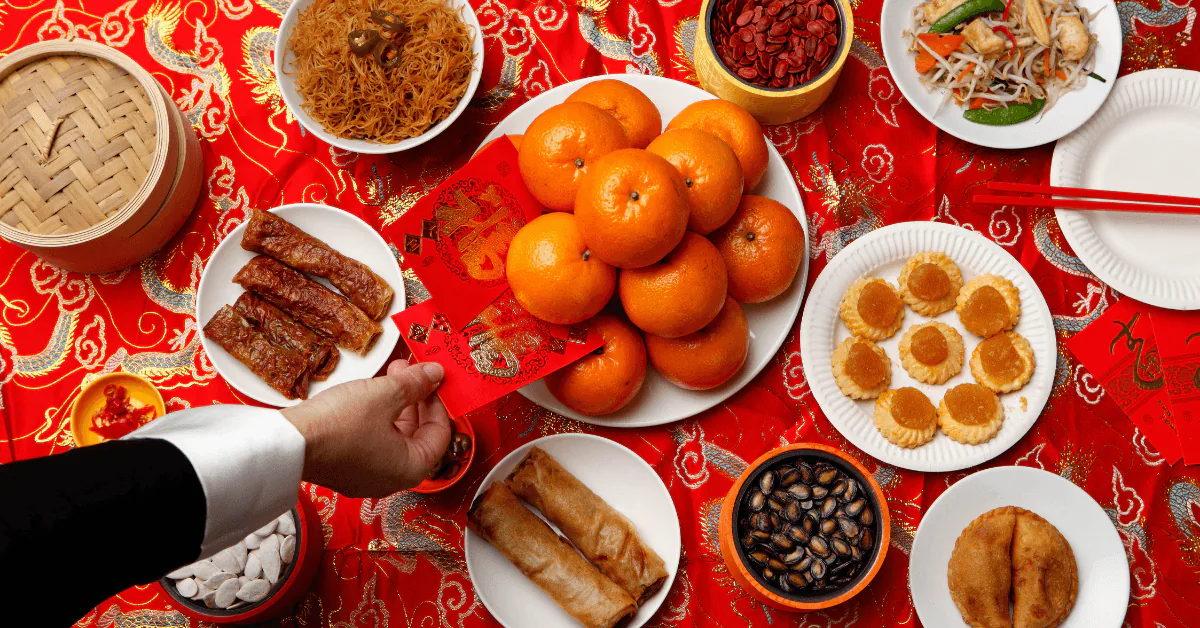
Lunar New Year is not one country’s holiday, and it is not on a fixed date. Both of those catch workplaces out, usually in the same email.
In 2027 it falls on Saturday 6 February, beginning the Year of the Goat. The date moves because it follows the lunisolar calendar: it is the second new moon after the winter solstice, which puts it somewhere between 21 January and 20 February every year.
It is not only Chinese New Year
The same new moon is the new year for a great many people, and they do not all call it the same thing or celebrate it the same way.
- China — Chunjie, the Spring Festival. Fifteen days, closing with the Lantern Festival.
- Vietnam — Tết Nguyên Đán, usually shortened to Tết. Different food, different flowers, and occasionally a different day, because the Vietnamese calendar is calculated on its own time zone and the new moon can land either side of midnight.
- Korea — Seollal. Three days, ancestral rites, and tteokguk, the rice-cake soup that traditionally makes you a year older.
- Also observed in Singapore, Malaysia, Indonesia, the Philippines, Thailand and across the diaspora, each with its own emphasis.
“Happy Lunar New Year” is the safe greeting when you do not know which a colleague keeps. “Happy Chinese New Year” is right for some of them and wrong for others, and the difference is noticed more than most people expect.
Japan is the common mistake in the other direction: it moved its new year to 1 January in 1873 and does not observe the lunar date at all.
The fifteen days
The Spring Festival is not a day off, it is a fortnight with a shape.
- New Year’s Eve — the reunion dinner, the single most important meal of the year, and the one people travel enormous distances for.
- Day 1 — no cleaning and no sweeping, which would brush the year’s luck out of the door. Red envelopes, hongbao, to children and unmarried adults.
- Day 2 — married daughters return to their own parents.
- Days 3–7 — visiting, and in some traditions a day when arguments are especially unlucky.
- Day 7 — renri, “everybody’s birthday”, counted as a shared birthday for the whole human race.
- Day 15 — the Lantern Festival, the first full moon of the year, associated with reconciliation and forgiveness. Sweet tangyuan are eaten because the round shape means reunion.
What actually happens
Red everywhere, because the colour repels bad luck. A thorough house clean before the new year, sweeping the old year’s misfortune out while it is still permitted. New clothes. Lion and dragon dances. Fireworks, historically to frighten off the nian, the beast the festival is named for.
And an enormous amount of food, most of which means something specific — which is a subject of its own, covered in Chinese New Year dishes and what each one means.
Marking it at work
- Get the date right and put it in the calendar early. It moves, it often lands on a weekend, and colleagues who observe it may want the surrounding days rather than the day itself — the reunion dinner is on New Year’s Eve, and the travel around it is famously the largest annual human migration on earth.
- Say “Lunar New Year” unless you know the person keeps Chinese New Year specifically.
- Do not hand out red envelopes as an office novelty. Hongbao has rules — who gives, who receives, and never an amount containing a four. Getting it wrong is worse than not doing it.
- Ask before decorating. Red and gold done properly is welcome; a wall of zodiac cartoons is not the same thing.
- The food is the safest and best gesture, and it is genuinely interesting, which is more than most themed lunches manage.
- Don’t make it the only cultural date you mark. The same rule as Diwali and Ramadan and Eid: one date in isolation reads as tokenism.
If you want a chef to run it
Rockoly’s Lunar New Year workshop puts a chef on the call and sends the ingredients out beforehand. Worth knowing what is on it before you book: the menu is pan-Asian rather than specifically Lunar New Year — bao buns and scallion pancakes sit alongside sushi, okonomiyaki and gyoza, and the Japanese dishes belong to a country that does not keep the lunar date at all. They make a good workshop; they are not a Spring Festival menu, and it is better to book it knowing that.
If you want the dishes that actually carry meaning at the reunion table, the Chinese New Year dishes post covers what to cook and why each one is on the table. Fortune cookies, incidentally, are not among them — they are an American invention and no part of the festival.