 Skip to content
January Team Events: Dry January, Veganuary and What Actually Works
January is the hardest month of the year to plan a team event for, and not for the reason people usually give. Your team comes back at different times, the budget has just reset, and a large minority of the room has quietly committed to a month without alcohol, or without meat, or both.
None of that makes January a bad month for an event. It makes it a month where the default event — drinks after work — excludes more people than usual. Below: what the two January commitments actually are, how to plan around them, and the framing to avoid.
Blue Monday is a travel advert, not a fact
You will read that the third Monday in January is the most depressing day of the year. It is worth knowing where that came from before you build a morale event around it.
The date was named by the psychologist Cliff Arnall in 2005, in a press release for the UK travel company Sky Travel, put out through a PR agency after the company noticed January bookings falling. The “formula” combined weather, debt, time since Christmas and time since your resolutions collapsed. Psychologists have dismissed it as pseudoscience ever since, and Arnall himself has spent years asking people to stop using it.
So: no, there is no worst day. What is real is that people return from leave at different times, a quarter of the team is on a personal challenge they have not mentioned, and nobody has any money. Plan for those three things instead.
Dry January: about one in five of your US team
Dry January began in 2013 as a public health campaign by the British charity Alcohol Change UK, with 4,000 participants. It crossed to the US and became mainstream: 22% of US adults over 21 took part in 2025, according to Morning Consult’s polling, up from roughly 17% a few years earlier, with the biggest increases among Gen X and lower-income adults. Health, not sobriety, is the reason most participants give.
For a team event in January, treat that as a planning constraint rather than a preference to ask about:
- Do not build the event on drinking. A January happy hour where the point is the cocktail asks a fifth of the room to sit it out or explain themselves.
- If you want a happy hour, make it alcohol-free for everyone. Our mocktail happy hour is exactly that — every kit is fully non-alcoholic with craft mixers, and a mixologist leads the session the same way. Nobody is drinking the “alternative”.
- Or make the drink beside the point. A cooking class where people are making dinner together does not need anybody to explain what is in their glass.
The version that fails is the one that offers “mocktails available on request”. That turns a private commitment into a request, in front of colleagues, which is the thing people are avoiding.
Veganuary: the same problem, at lunch
Veganuary is the January plant-based pledge run by a British non-profit of the same name, founded by Jane Land and Matthew Glover. Its first campaign, in January 2014, had 3,325 participants; it now runs at a scale of hundreds of thousands of formal sign-ups a year, with most large supermarkets and chains launching products against it.
The catering version of the Dry January problem is the same: a menu where the vegan option is an afterthought singles out whoever ordered it. The way round it is to pick something everyone is eating anyway.
That is what our New Year Reset menu is for. All three workshops are vegetarian and vegan as served, not vegan on request:
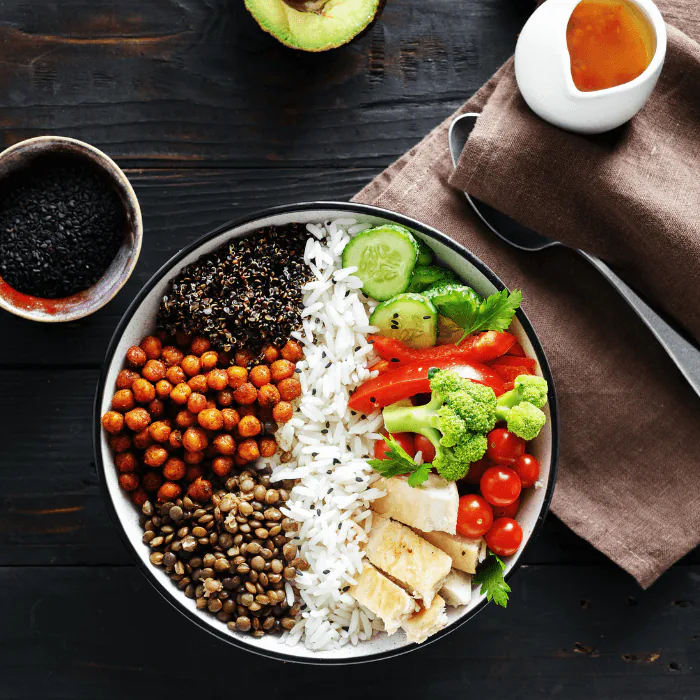
- Buddha Bowl — lentils, grains and vegetables under a tahini sauce. 60 minutes. Gluten-free as served.
- Chili Crisps Tofu — tofu crisped and tossed in a chili oil the team makes from scratch. 60 minutes. Gluten-free as served.
- Smokey Veggie Burger — a plant-based patty with avocado and roasted sweet potato fries. 60 minutes. Gluten-free on request.
Everybody makes the same dish, so there is no separate tray and no conversation about it. That is the whole point of the menu, and it is the one thing in this post that is genuinely hard to arrange yourself.
What not to do: the weight-loss framing
The commonest January mistake is not a logistical one. It is running a “wellness” event whose subject is, in practice, people’s bodies.
Weigh-ins, step-count leaderboards, “detox” or “get back on track” language, and before-and-after anything all turn a team event into a comment on how colleagues spent December. Some of your team have eating disorder histories you do not know about. Some observe fasts you have not heard of. Some simply had a hard Christmas.
A January event that works is about the food, the cooking or the game — not about improvement. Notice that everything above is framed as what we are making, never as what you should be doing differently. If you cannot describe your January event without the word “detox”, run a different event.
When in January to hold it
Late January, not the first week. The first working week is people returning, clearing inboxes and finding out what changed while they were away. An event in week one competes with all of that, and whoever is still on leave misses it entirely.
Avoid the last week if your fiscal year starts in January. Budget approvals are slowest in the first weeks of a new fiscal year, and the people who sign them are in planning. Book in early January for a late-January date, and the approval and the event both land in the right week.
Watch for Lunar New Year, which is often in the window. In 2027 it falls on 6 February, so a late-January event sits just before it. If part of your team celebrates, that is worth knowing before you schedule — and worth marking properly rather than folding into a January wellness event. There is a Lunar New Year workshop for that.
The practical part
Anything that ships needs about three weeks, because collecting home addresses takes longer than ordering does. For a Rockoly event, kits arrive at each person’s door a few days before the session, with free shipping in the US, and a live chef and a host run the session on Zoom — it is not a recording, so pick a time the team can actually make.
Everything on the New Year Reset menu runs 60 minutes. Dietary requests are free and handled per person, which for a January event mostly means the two or three people who need gluten-free beside a menu that is already vegan.
If a January event is not in the budget at all, that is a normal answer in January. The winter menu is the seasonal rate, and a quiz or a game costs nothing: our 100 trivia questions for corporate events and icebreaker questions both work on a call with no budget and no kit.
The one thing worth spending on in January is the thing that gets people in the same room, virtual or otherwise, after a month apart. It does not have to be improving.