 Skip to content

Wolves run in packs. Lions live in prides. Bees build hives. Geese fly in gaggles. But there is one species with a stronger collective dynamic than any other on Earth — humans.
We live together in family units, work together in teams, and co-exist in communities. Historically, we are the most collaborative species that has ever walked the Earth.
So why is it so easy for us to get stuck in the “silo” mentality in our work lives? We are more than a hive mind.
Each of us has our own qualities that add value to our workplace. And when individuals bring their strengths together to collaborate and solve problems, the results are generally pretty good.
Most of us will spend one-third of our lives at work — an average of more than 90,000 hours in a lifetime. Making the best of your working life is better for your mental health, job satisfaction, and self-esteem.
Nurturing a strong workforce is also in the best interest of your bottom line. According to the University of Oxford, happy employees are 13% more productive — and job satisfaction breeds better retention, while high turnover eats into profit.
So it just makes sense to cultivate a happier, more collaborative environment, and an effective team-building strategy is a great start. For too many managers, team building is dismissed as a “soft” exercise with little bearing on output. But motivated workers statistically outperform disengaged ones. Here are the four team building goals worth designing around — and how to actually hit them.
Stronger relationships
There is more to work than performing the function you’re paid for and going home. Nobody works in a vacuum. We all have dreams, stories, and quirks that don’t come out in everyday work interactions.
Team building surfaces the often-surprising qualities in people by putting colleagues into collaborative situations that need more sensitivity or flair than their day jobs do. A good team-building activity helps employees step out of their comfort zones and tap into skills their colleagues never knew they had — cooking a meal together, for instance, quietly reveals who plans, who improvises, and who keeps everyone calm.
Conquering a challenge together in a fun, low-stakes setting takes the pressure off. It’s less about winning than about getting people to step out of their predefined roles and connect on a personal level — which fosters the empathy, belonging, and loyalty that carry back into the workspace.
Better morale
We live in trying times, but none of us have to face everything alone. With a real sense of camaraderie, colleagues become a family away from home. Ohio State University found that groups that include friendships perform better, because friendship fosters trust and empathy.
Team building is one of the most effective ways to build those friendships — it takes people out of their usual settings and lets them interact socially, learning about each other as people. Laughing together raises everyone’s mood in the short term and builds an ongoing sense of belonging.
The everyday bonding rituals — water-cooler talk, sharing lunch — are harder to come by on a distributed team, which is exactly why a shared event matters more for remote workers. Something as simple as a virtual happy hour recreates the after-work unwind that remote teams otherwise miss.
Improved creative problem-solving
A 2018 report cited in Psychology Today found that groups with even basic training in creative tools produced 350% more ideas than untrained groups — and the ideas were 415% more original.
Creative problem-solving is the ability to think beyond your everyday responsibilities and try approaches you’d never considered: to see gaps in a process and streamline them, and to keep asking “why” instead of accepting things at face value.
Team building goals should challenge employees to use parts of their brains their prescribed roles don’t. A timed cook-off is a surprisingly good vehicle for this — hand a team a few mystery ingredients from the full workshop catalog and a deadline, and you get real-time delegation, improvisation, and creative pressure, minus the real-world stakes.
Better employee engagement
A report from Gallup shows engaged employees produce better business outcomes regardless of industry, size, or location — yet only about 15% of employees globally, and 35% in the U.S., are engaged.
When employees feel engaged, they feel a stronger sense of belonging — that they’re an important part of the greater whole. That feeling reduces stress and isolation. Team building nurtures it by building the interpersonal relationships a team leans on when it faces a challenge together. (If engagement is your priority, we go deeper on it in creative activities to boost employee engagement.)
Turning goals into an event
Goals are only useful if you act on them. The practical move is to pick one shared experience that hits several at once — a good cooking workshop builds relationships, lifts morale, and forces creative collaboration in a single hour. A few starting points:
- For a fully remote team: a live virtual cooking workshop or virtual team building cooking class, with ingredients shipped to every door.
- For a team in one place: in-person BBQ team building or a chef-led cooking event.
- For inspiration: our top 10 cooking team-building activities and 15 virtual team building activities lay out formats for every team and budget.
Fulfill your team building goals with Rockoly
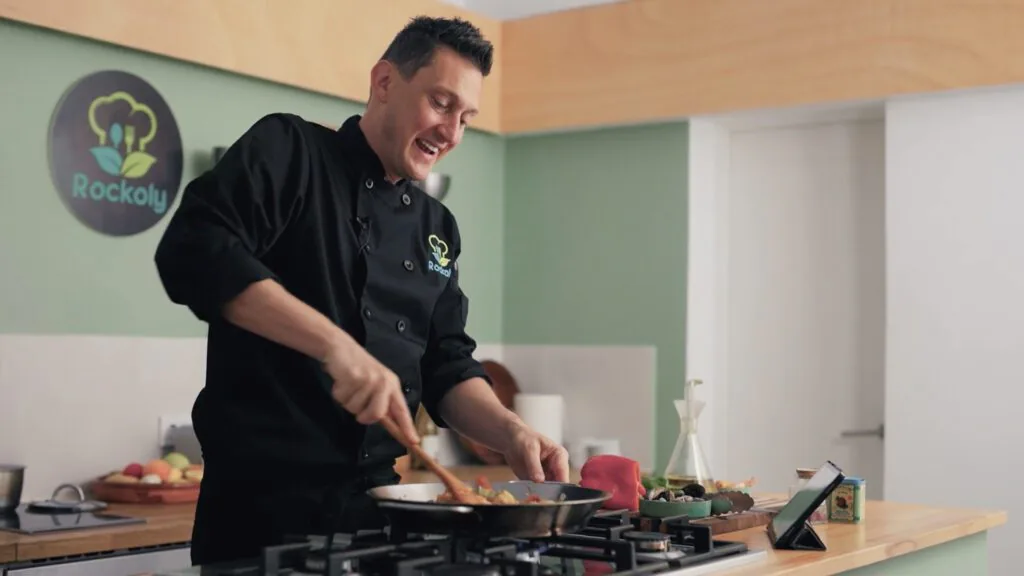
Rockoly brings remote and hybrid teams together with interactive, chef-led experiences that are collaborative by design. Choose from cooking workshops spanning pasta from scratch, Mexican street food, and dozens of global menus, plus wine tastings and happy hours — all customizable to your team.
The model is simple: ingredients or kits ship to everyone, a live chef and host run the event, and a dedicated planner handles the logistics and any dietary needs. You put in the appetite; we handle the rest.
Curious what it costs? We laid it out in How Much Does a Virtual Team Building Cooking Class Cost? When you’re ready, browse the rates, book your event, or hold your date and pick the menu later.