 Skip to content
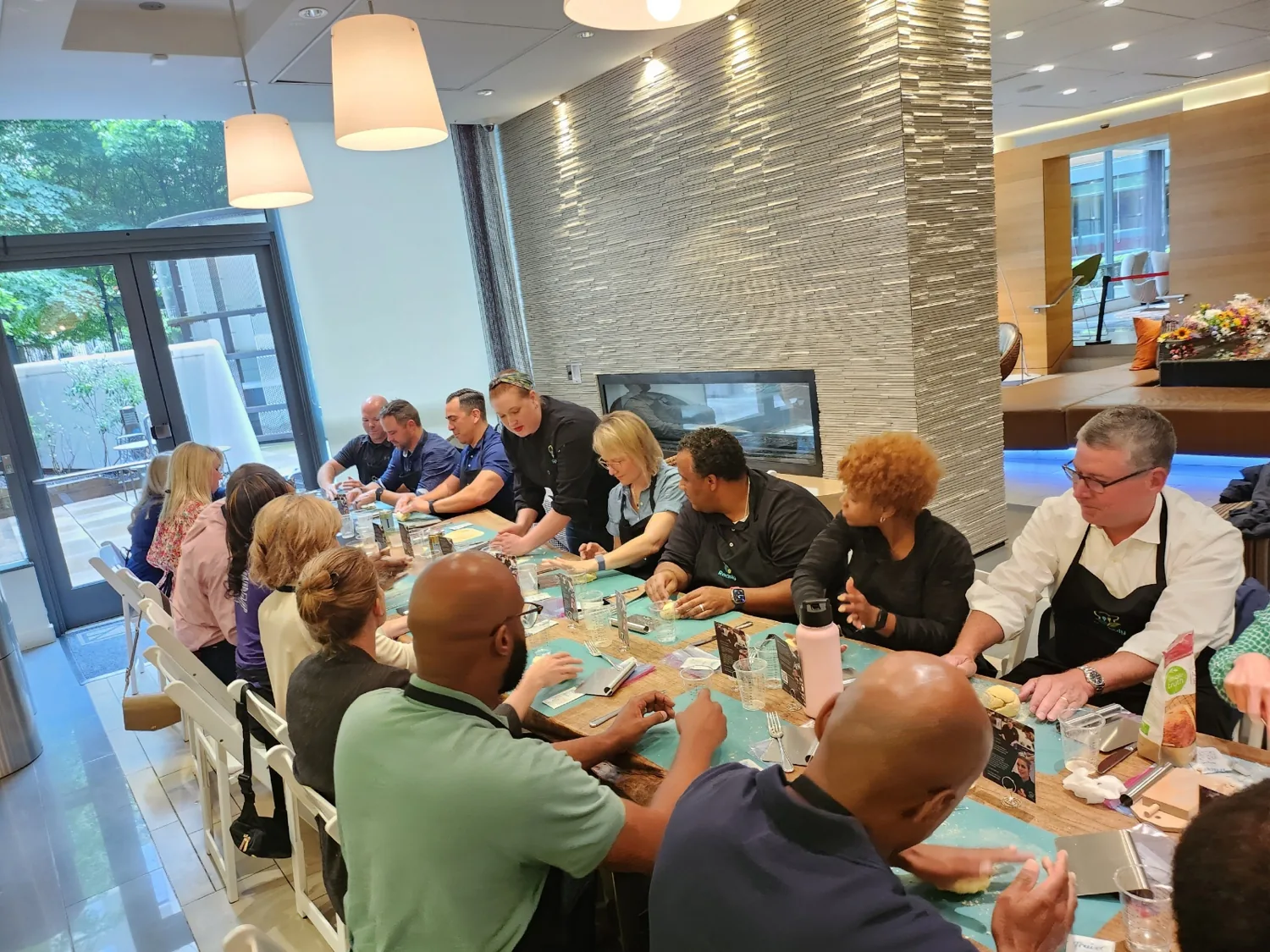
Most guides to team building activities in Philadelphia are a list of venues you then have to get forty people to. This one is the other way round: Rockoly’s Philadelphia events come to your office — Center City, the Main Line, and the areas in between — and the chef brings the ingredients, the supplies and the equipment.
That changes which decisions actually matter. Below: what it costs, how big a group can be, where to put it in the day, and the six formats.
Decide the room before the date
This is the one that moves the budget more than anything else.
Hosting in your own office starts at $150 per person. At a venue Rockoly arranges it starts at $250 — a two-thirds jump per head, which is why this is the decision to make first rather than last.
A conference room or an open floor is usually all it takes, so the office route is available to more teams than expect it. Your planner goes over the space with you before the day, and if your team is bigger than your biggest room, they book a nearby venue instead.
The room also sets how much runway you need, because a venue has its own calendar on top of the caterer’s.
What the price covers
The final figure is set by headcount, menu and location, and included every time:
- live instruction from the chef or mixologist
- all ingredients, supplies and equipment
- setup and cleanup by the Rockoly crew
- more food and drink than the group will get through
- a dedicated event coordinator
- free customizations
- event insurance
Optional extras are priced up front at $40 per person, and which one you can add depends on the menu: custom aprons with names or your logo on the four cooking workshops, a take-home cocktail shaker set with Mixology & Mingle, or a wine kit with Sipping & Socializing.
Group size: 3 to 600-plus
Headcounts run from 3 to 600-plus. The largest groups get split by department or spread across a couple of days rather than crammed into one sitting — worth knowing if you have been assuming a company-wide event is off the table.
Where to put it in the day
The workshop itself is two hours. Book the room for longer than that — the crew needs a slice either side to set up and clear — but this is not an afternoon-killer.
The placement matters more than the duration, and the reason is the food volume. Appetizers and non-alcoholic refreshments come with every menu as standard, and once you add the optional extras you are serving a meal: chicken piccata alongside Cavatelli & Competition, vegetable paella with Tapas & Talk, deli sandwiches and salad with Charcuterie & Connection.
So slot it over the lunch hour and it is lunch. Slot it at the end of the day and people eat, talk, and go home from there — rather than filing back to their desks at half past three with nothing left in them.
The six formats
All six run two hours and include appetizers and non-alcoholic refreshments.
- Cavatelli & Competition — fresh cavatelli and green pesto from scratch, with teams competing on the pesto. Extras: side salad and chicken piccata, tiramisu, wine and beer.
- Rolling & Bonding — a variety of Japanese maki rolls. Extras: chicken teriyaki with rice and cucumber salad, mochi, a sake tasting.
- Charcuterie & Connection — cured meats and cheeses, fruits, nuts, crackers, olives and jam. Extras: deli sandwiches and salad, mini cheesecakes, a wine tasting.
- Tapas & Talk — melon con jamón, pan con tomate, patatas bravas and piquillo de atún. Extras: vegetable paella, cinnamon churros, wine and sangria.
- Mixology & Mingle — a curated selection of cocktails crafted with expert mixologists, hands-on, with snacks and appetizers alongside.
- Sipping & Socializing — wines handpicked by Rockoly’s sommeliers, served with cheese plates.
Five are hands-on. Sipping & Socializing is the tasting on the list, so it is the one to pick for a group that does not want another task — closer to a guided wine tasting than a workshop.
And the In-Office BBQ
Newer and easy to miss: Rockoly also runs a Philadelphia In-Office BBQ, where the chefs bring the grill, the gourmet ingredients and all the equipment to your workplace — burgers through to BBQ classics. If you have outdoor space, ask about BBQ team building rather than defaulting to a cooking workshop.
Why this beats the escape room you already did
Food is the difference, and it is a bigger one than it sounds.
An escape room gives a team a puzzle and forty minutes of adrenaline. Two hours at a bench gives them a task with a physical result — a board, a plate, a drink they made — and, more usefully, it gives their hands something to do while they talk. Conversation that happens sideways over a chopping board is the kind you cannot manufacture with an icebreaker round.
It is also unusually level ground. Nobody in your company is good at rolling cavatelli. The person who joined on Monday and the person who runs the department are both going to make a mess of it for the first ten minutes, and that is worth more to a room than any trust exercise.
Then everyone eats, which is the part no escape room has ever managed.
Dietary needs are planned in, not worked around
Vegetarian, vegan, gluten-free, kosher and no-alcohol requests go onto the shopping list once you share them, and they never cost extra. The person who cannot eat gluten cooks their own version of the dish rather than watching.
Menus are equally flexible — pair Tapas & Talk with a cocktail session, or swap a dish that will not land with your crowd. Send the details when RSVPs close.
A Philadelphia food fact worth deploying
Philadelphia Cream Cheese has never had anything to do with Philadelphia.
It was invented in 1872 by William Lawrence, a dairyman in Chester, New York, who was aiming at a copy of French Neufchâtel and arrived somewhere else entirely. The city’s name got bolted on eight years later, in 1880, for no reason other than marketing: Philadelphia at the time was a byword for good food and good dairy, so the label borrowed the reputation.
A piece of 19th-century brand positioning that has comfortably outlived everyone who had a hand in it. Save it for Charcuterie & Connection, when there is a table of cured meats, cheeses, fruit, nuts, crackers, olives and jam in front of everyone and somebody is bound to disagree.
Lead time and booking
About three weeks for a cooking workshop and four for a happy hour. Rush dates do happen when a chef is free, so ask rather than give up on a tight timeline.
A deposit holds the date. Cancellation for in-person events works on a day-based ladder rather than an hours-before cut-off, and it is worth reading before you commit a budget: 30 or more days out you are refunded what you paid less any nonrecoverable costs already committed; 15 to 29 days out you choose between a 50% refund and a 100% Rockoly credit; inside 15 days payments are nonrefundable, though one complimentary reschedule is yours if you ask 30 or more days ahead. The cancellation policy quotes the same windows, and the event terms control where any summary differs — check them there rather than taking this paragraph’s word for it.
The inquiry form on the Philadelphia events page is the quickest route to a planner.
If part of the team is remote
Rockoly’s virtual cooking classes ship ingredients to each participant instead, which is the version that works when the team spans several cities — and the virtual catalog has the full range. Plenty of the same menus appear in both.
Other cities
Rockoly runs the same in-person formats in Washington DC, New York, Boston, Chicago, Seattle, the Bay Area, Southern California, Austin and Columbus — see the in-person events page for the current list.
Keep reading
- Team Building in Washington DC: Cooking, Mixology & Wine
- Bay Area Team Building: Cooking, Cocktails & What It Costs
- Los Angeles & Southern California Team Building: Rooms, Menus, Costs
- NYC Cooking Classes for Team Building
- Best Massachusetts Locations for Corporate Team Events
- Cooking Competitions That Bring Teams Together
- Chicago Team Building: How the Drinks, Menus and Lead Times Work
- Austin Team Building: Dates, Headcount and What Each Change Costs
- Seattle Team Building: Hybrid Events, Kit Shipping and What It Costs
- Columbus Team Building: The Way In, the Menus and What It Costs