
Seattle Team Building: Hybrid Events, Kit Shipping and What It Costs
Ten Rockoly metros have a page like Seattle’s; Seattle’s answers the remote half in more detail than the other nine. Four of its eight FAQs touch people who will not be in the building, two speak straight to them, and a third — on lead time — holds the most useful planning sentence on the site.
That emphasis is not decoration. Rockoly’s Seattle in-person events run six two-hour menus from downtown out through Bellevue and Redmond, at from $150 per person in your own room or from $250 at a venue. Dialling part of the team in barely changes the event. It changes the calendar completely.
The remote half is part of the same booking
The Seattle page treats a hybrid as an ordinary option, not a fallback: the room works the menu with the chef standing in it, while everybody else works the identical menu at their own counter from a kit that arrived at their door, a video host holding both groups in one conversation.
Zoom is the default, and Google Meet, Teams and WebEx work if your company runs on something else. The in-person events page puts the technical side on Rockoly rather than your IT department, end to end. Groups run from three people to six hundred and beyond.
Count the runway from the shipping label, not the chef’s diary
Seattle’s stated lead time is three weeks for a cooking event, four for a happy hour, though a rush date is worth raising when a chef has the day free.
Then comes the override, the sharpest line on the page. Running this as a hybrid, in the page’s own words, means you “count from the shipping, not the chef, because the kits have to reach every address before the day. That is the deadline that actually moves.”
The kit catalog puts arrival a few days ahead and asks for orders three weeks out, because every box is assembled and shipped to an individual address. A chef’s diary can be talked around. A carrier’s cannot.
How far a kit will actually travel
Standard shipping is free anywhere in the US, and international delivery is real too — Seattle’s page names Canada, the UK, Australia and Germany among others — which turns a colleague in Berlin from a problem into a shipping question.
The fine print differs by page. The Charcuterie Kit page is blunt: international delivery “is available to most countries at additional cost, and those addresses are due earlier”. The kit catalog says only that it is available on request; the virtual events hub says teammates outside the US cost nothing extra. Ask which applies before promising anything.
Ingredients for the room arrive with the chef, not by courier — no commercial kitchen needed. On a hybrid, the remote half is the only part of your event on a delivery clock.
The room sets the clock
The page is honest here. A hybrid works, but the room fixes the start: the chef cooks for a fixed two hours, and anyone joining live is on Seattle time — comfortable enough on the East Coast, much less so in Europe or Asia.
Give your coordinator the actual geography at booking, before invitations go out. You get a straight answer on which start times work for whom — in Munich, that may be none.
When the spread is too wide, ask for two sittings
The remedy is not a compromise start at five in the morning. It is running the thing twice: the in-person event on Seattle time, then a second run of the identical menu, virtual, timed for Europe or Asia, with kits sent to each of those addresses.
That sounds like double the work, but the page frames splitting as an upgrade: large groups get divided by team or across days anyway, and a smaller group gets more of the chef. The virtual sitting is priced openly, with live per-person rates on the virtual events hub. Whether two sittings bill as two events is unpublished, so raise it early.
Who is in the room, and who minds the screen
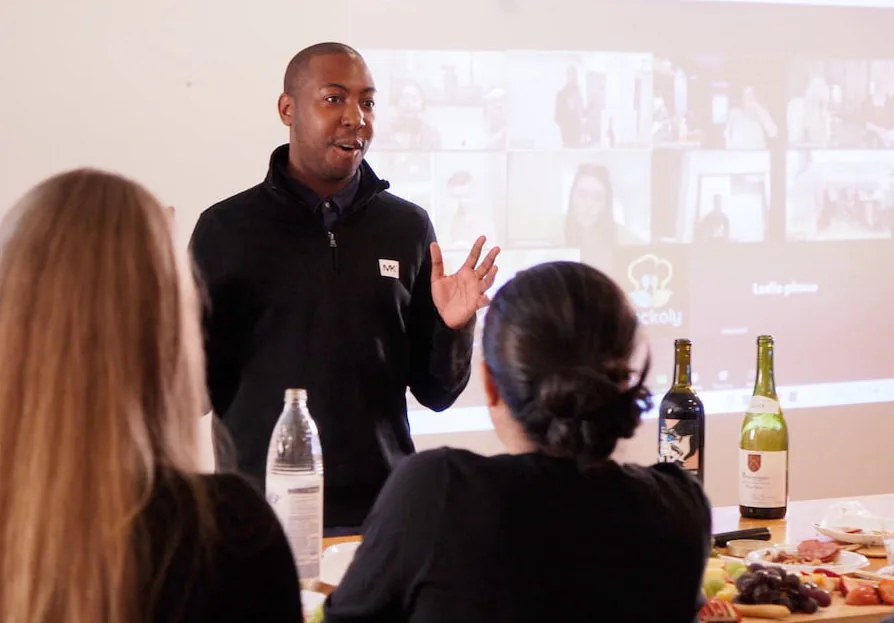
Staffing is spelled out by role: a chef or mixologist leads and coaches each station, event helpers prep ingredients and build the stations, and a separate crew sets up beforehand and puts the space back after. Two hours covers the lot, first appetizer to last dish washed.
On a hybrid the coordinator picks up a second job: keeping the remote half from becoming an afterthought — kits to home addresses, a host who keeps the screen inside the room’s conversation, and a camera angle putting the chef’s hands in front of Bellevue and the home kitchens alike.
What a head costs, and what the number carries
All six menu cards print the same floors: from $150 per person in your own office, from $250 at a venue. Floors, not quotes — the rate follows the menu and the headcount.
Event insurance is in the price, and so is the cleanup: live instruction, every ingredient, all supplies and equipment, the Rockoly team setting up and clearing away afterwards, food and drink past the point anyone is still hungry, and a coordinator whose customizations cost nothing.
Customizing is free — mix two menus, adjust dishes, or bolt the Haiku Challenge onto the sushi workshop. Only named extras move the number: a sake tasting, mochi for dessert, chicken teriyaki as a main, or custom aprons at $59 a head.
Six menus, every one of them two hours
- Cavatelli & Competition — pasta and pesto from scratch, judged on flavor; pairings, a main and tiramisu are upgrades.
- Rolling & Bonding — Japanese maki, from seasoning the rice to plating; sake etiquette, mochi and teriyaki are add-ons.
- Charcuterie & Connection — meats, cheeses, fruit, nuts, olives and jam built into boards as a group; add a tasting or deli buffet.
- Tapas & Talk — patatas bravas, pan con tomate, piquillo de atún, sangria alongside, a leg of jamón as the showpiece.
- Mixology & Mingle — the happy hour of the set: bartenders, classic and seasonal drinks, everybody behind the bar.
- Sipping & Socializing — a sommelier-guided tasting, bold reds through crisp whites, built for talking.
No seasonal tier here: December’s list is June’s list.
A seventh option that arrives with a grill
The Seattle BBQ Bash appears as a feature rather than a priced card: chefs bring the grill, ingredients and equipment to your workplace, burgers through the barbecue classics. It has its own barbecue team building page and its own pricing, so the floors above do not apply. It also answers a building that bans indoor cooking — but only with outdoor space, since that page requires open air, clearance from the building and roughly 15 by 15 feet per station. Without it, the three no-heat menus are the fallback.
Teriyaki is a Seattle invention, not an import
The teriyaki counters scattered across the region trace back to one 1976 storefront near Seattle Center: Toshihiko Kasahara’s Toshi’s Teriyaki, which sold chicken thigh over rice under a sweet soy glaze and nothing else. Cooks who trained with him opened their own shops, and their cooks opened more, until there were hundreds. Invented here rather than carried in.
The story has somewhere to land: Rolling & Bonding is the Japanese session, where the first real skill is seasoning sushi rice and spreading it without crushing the grains, and chicken teriyaki is one of the mains you can add.
Dietary needs ride the shopping list, not the invoice
There is no surcharge for any of it — vegetarian, vegan, gluten-free, kosher, no-alcohol — provided the kitchen is told before the shopping happens.
On a hybrid that condition has teeth: a remote guest’s requirement means a different box, not a different plate. The event terms and conditions set hard deadlines — dietary information at least ten days before an in-person event, fourteen before a virtual one, so a hybrid runs both clocks. Past them Rockoly is not responsible for undisclosed restrictions and cannot guarantee every request is met. Late is not more expensive; late risks not being accommodated at all.
The same terms make participant substitutions free “when no shipping change is required” and stop there — nothing published says what a swap that does force a new box costs, so ask. The itemised list of replacement ingredients, new kits and shipping belongs to the rescheduling clause.
Cancelling runs on days, and one thing this page does not say
Start with the friendliest clause: one complimentary reschedule if you ask thirty or more days ahead. Know what a later move costs: at 15 to 29 days the fee is 10% of the event subtotal or $500, whichever is greater, and inside 15 days it is 25% or $1,000. The rescheduled event must take place within twelve months of the original date, and once an event has been rescheduled any later cancellation is eligible for Rockoly credit only, not a refund.
The refund ladder counts days. At 30 days or more you get back what you paid, minus nonrecoverable costs already committed. From 15 to 29 days it is your choice: a 50% refund of the recoverable event amount, or a Rockoly credit for 100% of that same amount — good for twelve months, transferable inside your organization, no cash value, so that trade is only even if you rebook inside the year. Inside 15 days, payments are not refundable. The cancellation policy quotes the same windows; where any summary differs, the event terms above control.
One wrinkle: Rockoly publishes two ladders, virtual and in-person, on different day counts. Seattle prints the in-person tiers, so ask which governs a booking that also ships kits — the page does not say.
Holding the date itself is the simple part: a deposit does it, by credit card, ACH transfer or check. The general in-person events page carries the same terms if you want them beside the rest of the network’s.
Every Seattle event carries the Love Your Event Guarantee: if it falls short, Rockoly will make it right. The inquiry form on the Seattle events page is the fastest route in; events@rockoly.com and (617) 939-9732 land with the same team.
Other cities
Nine more metros have pages of their own: Austin, Bay Area, Boston, Chicago, Columbus, New York, Philadelphia, Southern California and Washington DC. Most run the same menus at the same floors. Washington DC answers the hybrid question too, but stops at ingredients delivered to remote colleagues; the platform list, time zones and shipping deadline are Seattle’s alone.
Keep reading
- Team Building in Washington DC: Cooking, Mixology & Wine
- Team Building Activities in Philadelphia: Cost and Formats
- Bay Area Team Building: Cooking, Cocktails & What It Costs
- Los Angeles & Southern California Team Building: Rooms, Menus, Costs
- Chicago Team Building: How the Drinks, Menus and Lead Times Work
- Austin Team Building: Dates, Headcount and What Each Change Costs
- Columbus Team Building: The Way In, the Menus and What It Costs