 Skip to content
Diwali is the largest festival in the world that most Western workplaces mark badly, if at all. The usual attempt is an email with a diya emoji, or a “Diwali lunch” of chicken tikka masala, which is roughly the equivalent of marking Christmas with a plate of nachos.
It deserves better, and getting it right is not difficult. Below: when it falls and why the date moves, what it actually commemorates — which is not one thing — the food that belongs to each of the five days, and the specific mistakes worth avoiding.
When Diwali falls, and why it moves
Diwali follows the Hindu lunar calendar. The main day is the new moon of the month of Kartika, which lands somewhere between mid-October and mid-November in the Gregorian calendar and shifts by about eleven days a year.
In 2026 the five days run Friday 6 to Tuesday 10 November, with the main day on Sunday 8 November.
| Day | 2026 date | What it is |
|---|---|---|
| Dhanteras | Fri 6 Nov | The wealth day. Households buy metal — gold, silver, or just a steel pot — and clean the house thoroughly. |
| Naraka Chaturdashi (Choti Diwali) | Sat 7 Nov | The “little Diwali”. An early ritual bath, the first lamps, and most of the cooking. |
| Diwali / Lakshmi Puja | Sun 8 Nov | The main day. Lamps everywhere, the puja to Lakshmi after dark, fireworks, families together. |
| Govardhan Puja / Annakut | Mon 9 Nov | A “mountain of food” offered at the temple — in some regions the new year. |
| Bhai Dooj | Tue 10 Nov | Brothers and sisters. The counterpart to Raksha Bandhan. |
The main day in 2026 is a Sunday, which matters for planning: colleagues who celebrate will most likely want the Friday and the Monday flexible rather than the day itself.
What Diwali actually commemorates
This is the part most workplace guides get wrong, usually by picking one story and presenting it as the story.
It is not only a Hindu festival. Hindus, Jains and Sikhs all observe it, on the same days, for different reasons.
- Hindus — and even here it varies by region. In the north it is Rama’s return to Ayodhya after fourteen years of exile and the defeat of Ravana, welcomed home by rows of lamps. In the south it is Krishna’s defeat of the demon Narakasura. In the west it marks Vishnu sending the demon king Bali to rule the netherworld. In Bengal the same night is Kali Puja, which is a different observance again.
- Jains mark the night Mahavira — the last Tirthankara of this era — attained moksha.
- Sikhs observe Bandi Chhor Divas, “the day of liberation”: Guru Hargobind’s release from imprisonment at Gwalior Fort, and his refusal to leave without the Hindu princes held with him. The Golden Temple at Amritsar is lit for it.
What the three share is the lamp and what it means — light over darkness, good over evil, knowledge over ignorance. That is the safe thing to say if you are saying anything, and it is true of all of them.
One practical consequence: a Sikh colleague wished “happy Diwali” may gently correct you to Bandi Chhor Divas, and is not being difficult. “Happy Diwali” is widely accepted and widely used; if you know someone observes Bandi Chhor Divas, using that name is a small courtesy that lands well.
The food
Diwali food is overwhelmingly sweets and fried snacks, made in quantity and given away. It is not curry.
Mithai — the sweets, and the center of the whole thing:
- Ladoo — spheres, most often besan (gram flour) or boondi. The default gift.
- Barfi — a set, sliced fudge: kaju (cashew), pista, coconut, or plain milk barfi. Kaju katli, the diamond-cut cashew one, is the prestige version.
- Jalebi — batter spirals fried and soaked in syrup, eaten hot.
- Gulab jamun — fried milk-solid dumplings in rose syrup.
- Peda, halwa, rasgulla, and a hundred regional others.
Namkeen — the savory half, and the reason nobody is hungry for dinner:
- Chakli or murukku — spiral fried snacks, crunchy and cumin-heavy.
- Mathri — flaky, salty, keeps for weeks.
- Namak pare, sev, chivda, spiced nuts.
Meals vary hugely by region and are often vegetarian, and on Govardhan Puja the offering is deliberately enormous — annakut literally means “mountain of food”.
The gifting matters more than the eating. Boxes of mithai go to neighbors, colleagues, clients and anyone who has done you a good turn that year. If you want one gesture that is both authentic and easy, that is the one: a good box of sweets, given rather than served.
Marking it at work, without it being awkward
- Ask someone who celebrates, first, and give them the choice to decline. The most common failure is a well-meant plan assembled entirely by people who do not observe it.
- Do not make one colleague the entertainment. “Priya, would you explain Diwali to everyone?” turns a person into an exhibit. Invite, don’t conscript — and if they want to lead something, that is different and obvious.
- Handle the leave properly. This is worth more than any event. The main day is often a working day, families travel, and temple visits and pujas happen after dark. Flexible hours around the five days, and leave granted without a fight, is the thing people actually notice.
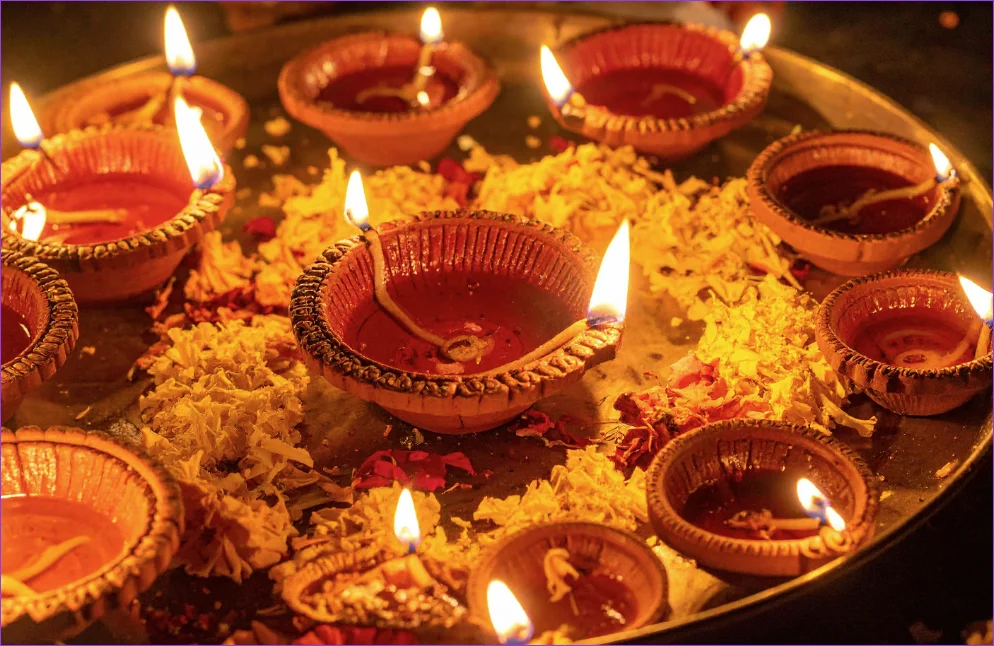
- Light something. Diyas or tealights on the desks is the simplest, most universal gesture and costs almost nothing. Check your fire policy; LED diyas exist for a reason.
- Rangoli. Colored powder or chalk patterns at the entrance. Genuinely fun as a group activity, and the one participatory thing that does not require anyone to perform their heritage.
- Sweets, properly. Order from an actual Indian sweet shop rather than assembling a supermarket approximation. Label everything: mithai is usually vegetarian but frequently contains dairy, nuts, and sometimes silver leaf.
- Get the food right if you do food. A vegetarian thali, chaat, or a mithai spread is closer to the festival than a curry buffet. And if the office does eat together, remember that many observe a vegetarian diet during the festival.
What not to do
- Don’t call it “Indian Christmas.” Different calendar, different religions, different meaning, and it flattens three faiths into a comparison nobody asked for.
- Don’t schedule the celebration on the main day and expect full attendance. That is the family evening. The Thursday before is usually a better office date than the Sunday itself.
- Don’t buy fireworks. Beyond the obvious safety and legal problems, fireworks are the most contested part of the festival even within India, where air quality after Diwali is a serious public health issue and several cities restrict them.
- Don’t do costumes. A sari or kurta worn by someone who was invited to wear it is participation; the same thing handed out as a party novelty is not.
- Don’t assume everyone Indian celebrates it. India has large Muslim and Christian populations, among others, and plenty of people who simply do not observe.
- Don’t let it be the only cultural date you mark. A Diwali lunch in an office that ignores Eid and Lunar New Year reads as tokenism, because it is. If you are starting somewhere, say out loud that it is a start.
If you want to cook something together
Rockoly does not run a Diwali-specific workshop, and this post is not an advertisement for one. What it does run is a live Indian Tikka Masala class — 90 minutes, chicken tikka masala with basmati rice and naan made from scratch, with vegetarian, vegan (chickpeas for the chicken) and gluten-free versions — which is a good cooking session and is honestly a British-Indian restaurant dish rather than a festival one. If that is what your team wants, it is a genuinely fun evening. It is not a Diwali observance, and it is better not to bill it as one.
The cultural and seasonal events page has the dates Rockoly does build programs around, and the Asian and Pacific Islander heritage workshops are the closest thing to a cultural-celebration format.
For an actual Diwali gesture, the ranked order is unglamorous and effective: give the leave, then light the lamps, then send the sweets. The catering is the least important part, which is the opposite of how most offices approach it.