 Skip to content


Most corporate events do not fall apart. They drift. Nobody cancels; the number just moves — four added on Tuesday, three pulled into a client visit on Thursday, and by the morning the list you booked against is not the list at the door.
In Austin that drift is the expensive part, because so little else varies. Rockoly’s Austin in-person events run six menus, all two hours, all printing the same pair of floors. No menu starts cheaper than another — but the quote still follows the menu as well as the headcount. Your date and your number do the rest.
The one number that will not sit still
The Austin page’s instruction is one sentence: tell your planner the new figure as soon as you have it. It reads like courtesy; it is arithmetic.
Three things are built from your headcount alone: the ingredient order, the station layout, and how many chefs and helpers are in the room. Change the number and all three are rebuilt. The page frames this as workload rather than penalty: seven days of notice buys an email, the same news on the morning buys a scramble.
What a late change actually costs
An increase is a supply question: more ingredients, more station space, possibly another pair of hands. The answer depends on what is still available when you ask.
A reduction is a money question, and timing settles it. Once the ingredients have been bought, the Austin page says a late reduction cannot always be credited back.
If the shrinkage has you eyeing the exit, say so rather than cancelling: the cancellation policy points teams toward a reduced group instead of scrapping the date, keeping the deposit and the chef in play.
The deadline that actually governs
Each menu page publishes its own working deadline — headcount adjustable to twelve days out, plus a confirm-headcount-and-space step a week before. The contractual one is in the cancellation-and-changes section of the event terms and conditions: where any other page or summary differs, that section controls, and a signed proposal or event confirmation outranks even that.
Final confirmation there falls ten business days out — two working weeks, not ten days. Before it, an estimated count may be trimmed by up to twenty percent, but never below the minimum written into your own booking. The catalog floor is three people; your contracted minimum is set in your proposal, so ask which numbers govern yours. Reductions after it are nonrefundable.
Swapping one attendee for another is free where no shipping changes, and an Austin event ships nothing — the chef arrives carrying it. An event that cannot go ahead because the room, the access or the team never materialises counts as a same-day cancellation, full payment due; one person not turning up is simply a headcount you already confirmed.
Who is in the room, and which of them scale
Five roles are attached to your event, and the page ties two of them to the figure you gave — the chefs and the helpers. A chef or mixologist runs and teaches; an event planner designs the menu, timeline and room layout with you beforehand; helpers prep and restock stations; servers handle appetizers and refreshments; a cleanup crew leaves the office looking untouched.
So adding twelve people quietly is a staffing adjustment, not a catering one, and staffing is booked ahead.
Six menus, one pair of numbers
Austin’s lineup does not shift with the season — no holiday tier here, unlike some other Rockoly cities. February’s list is November’s.
- Cavatelli & Competition — cavatelli shaped by hand, pesto from scratch, judged on the most flavorful result.
- Rolling & Bonding — sushi rice and Japanese maki, plating included; sake etiquette and mochi are extras.
- Charcuterie & Connection — cured meats, cheeses, fruit, nuts, crackers, olives and jam, built into boards as a group — assembly, not cooking.
- Tapas & Talk — pan con tomate, patatas bravas and a whole leg of jamón as the centerpiece, sangria alongside.
- Mixology & Mingle — expert bartenders, everyone hands-on behind the bar, classic cocktails and seasonal sips.
- Sipping & Socializing — a sommelier-guided tasting from bold reds to crisp whites.
Every card shows the same two rates: from $150 a head in your office, from $250 at a venue Rockoly lines up. Both are floors, not quotes — pricing follows the menu and the headcount. The office event format sets out the same split, and the in-person catalog shows these six alongside the BBQ menus and other cities’ seasonal workshops.
The Austin page names two extras that move the figure, both $40 per person: aprons carrying your logo, and the take-home shaker set attached to Mixology & Mingle. Individual menu pages carry their own — Sipping & Socializing lists a $40 wine kit — plus upgrades like wine pairings, a main dish or dessert. Blending menus adds nothing.
Twice a year, the city’s calendar outranks yours
Allow roughly three weeks of notice for a cooking session and a fourth for a happy hour; the site FAQ gives the same figures. Then check your date against the city, not Rockoly.
The Austin page names two stretches where the constraint stops being chef availability and becomes the city itself: it fills up around SXSW in March and Austin City Limits in the autumn. The advice attached is deliberately unquantified — ask early rather than late. No multiplier is published, so let a planner tell you what is free.
A tight date is still worth raising; these sometimes work when a chef’s day is open. But speed is not free — the event terms allow an express booking fee inside fourteen days.
One event, wherever the desks sit
Coverage runs from downtown out through Round Rock and Cedar Park and beyond, so a satellite office is no reason to gather everyone downtown.
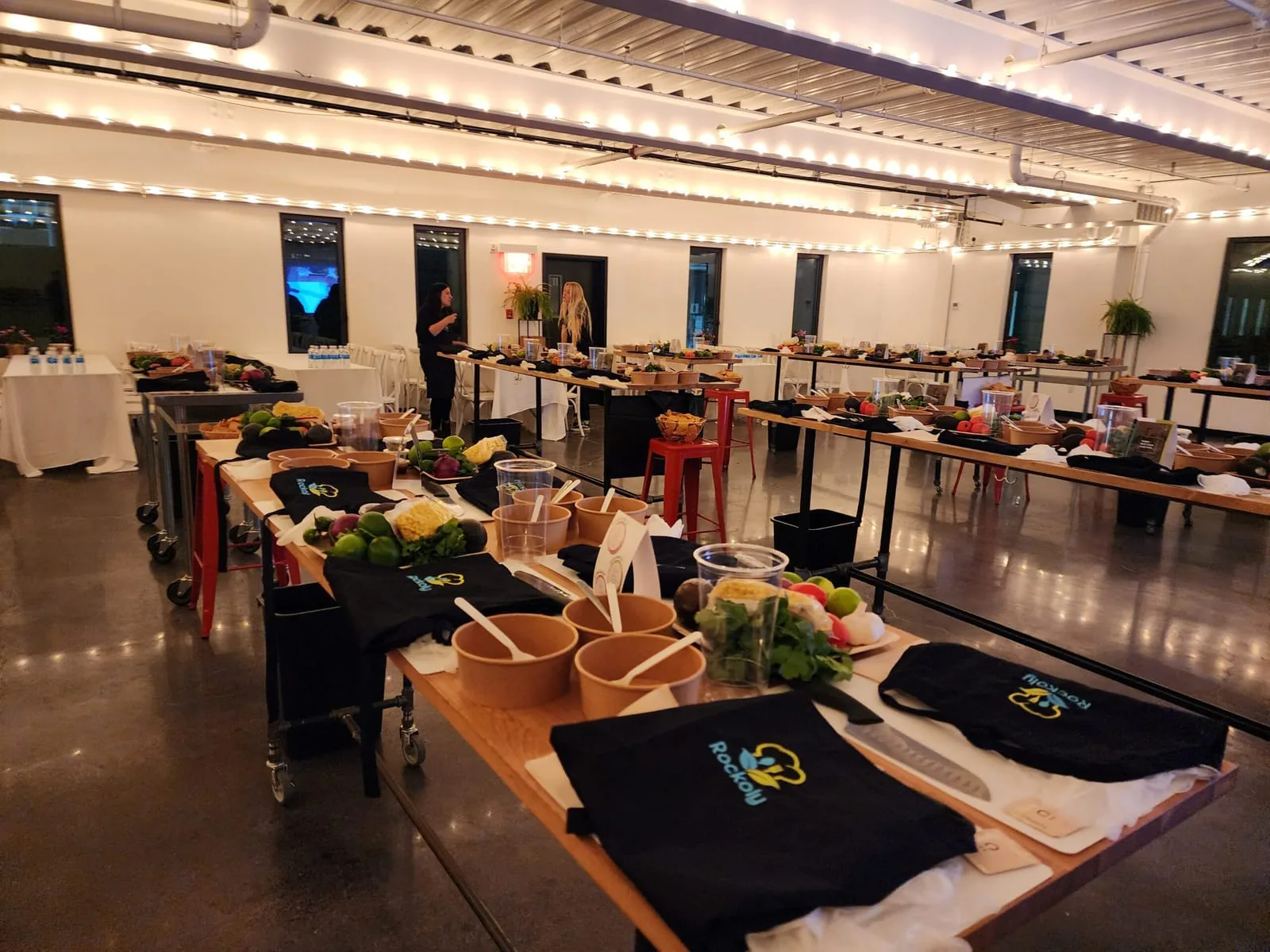
Plenty of Austin events run in the client’s own office. The chefs bring equipment, ingredients and stations, so your side is a room with tables, a sink and somewhere for the chef to set up; the planner checks the room, the tables and the power beforehand rather than on arrival. If hosting is awkward, Rockoly books a venue nearby, the $250 row on every card.
What the two hours actually look like
The chef arrives ahead of your group and sets up. Themed appetizers and non-alcoholic refreshments are out from the start, so early arrivals have somewhere to go.
Then the room splits into small teams, each with a job. The chef moves between them rather than lecturing from the front, correcting a grip at one table, calling timing at the next. The last stretch is everyone eating what they made.
Nobody needs experience; the menus are picked so someone who has never cooked still plates something worth eating in two hours, and Rockoly has run over a thousand events on that assumption.
Dietary notes ride the same list as the count
Treat dietary requirements as part of the headcount conversation, not a separate errand: the person added on Thursday may well be the vegan.
Vegetarian, vegan, gluten-free, kosher and no-alcohol options all come at no additional cost when shared in advance. The Austin page asks you to tell your planner as early as you can when something changes; the event terms are firmer, requiring dietary information at least ten days out. Work to the firmer number.
Central Texas barbecue began with the cuts that didn’t sell
Central Texas barbecue did not start in restaurants. German and Czech immigrants ran the meat markets here in the nineteenth century, and whatever had not sold by closing went into the smoker. It came back out priced by weight, on butcher paper with bread, pickles and nothing resembling cutlery. Standing around the pit to eat — the habit that makes barbecue such useful team food — began as a butcher’s answer to unsold stock.
If your building has outdoor space, barbecue team building is a real alternative. Grills need open air and clearance from the building, so this one cannot move indoors, and that page prices three packages of its own from $140, $210 and $230 per person rather than at the Austin card rates.
The deposit, the reschedule and the day-based ladder
Start with the useful half: one complimentary reschedule at thirty or more days’ notice — enough runway for most reasons a corporate date slips. Move it later and fees apply on a tier. Once an event has been rescheduled, a later cancellation is settled in Rockoly credit rather than cash.
Refunds run on days, never on hours. Thirty days out or more, you are refunded what you paid less any nonrecoverable costs already committed on your behalf. Between fifteen and twenty-nine days you choose: a 50% refund of the recoverable event amount, or a Rockoly credit for 100% of that same amount — the deposit non-refundable except where the terms expressly say otherwise. Inside fifteen days, payments are not refundable.
Early is cheap and late is not. Check the windows on the cancellation policy; the event terms add that where committed costs are charged you owe the greater of the stated percentage or the documented third-party costs, never both.
A deposit holds the date — credit card, ACH transfer or check — and every booking carries the Love Your Event Guarantee.
If part of the team sits outside Texas
These six menus are in-person only. A genuinely distributed team is better served by a virtual cooking class, where ingredients ship to each address rather than to one office.
When Austin is the date you want, send a headcount and a couple of dates through the form on the Austin events page; a planner returns open dates, menu options and a quote.
Other cities
Nine more metros have pages of their own, each with its own coverage area: Bay Area, Boston, Chicago, Columbus, New York, Philadelphia, Seattle, Southern California and Washington DC. Most run the same six menus at the same rates; Bay Area, Boston and Chicago add two seasonal ones Austin does not.
Keep reading
- Team Building in Washington DC: Cooking, Mixology & Wine
- Team Building Activities in Philadelphia: Cost and Formats
- Bay Area Team Building: Cooking, Cocktails & What It Costs
- Los Angeles & Southern California Team Building: Rooms, Menus, Costs
- Chicago Team Building: How the Drinks, Menus and Lead Times Work
- Seattle Team Building: Hybrid Events, Kit Shipping and What It Costs
- Columbus Team Building: The Way In, the Menus and What It Costs