 Skip to content

There is a scheduling fact about the Bay Area that nobody mentions until it bites: one chef roster covers San Francisco, the Peninsula, the South Bay and the East Bay. Four sub-regions, one calendar. So when two companies forty miles apart both want the same Thursday in October, that is a genuine conflict rather than a formality — and the one who asked first gets it.
That single constraint should shape how you plan a Bay Area team event more than the menu does. Below is what the formats are, what a head actually costs, and the questions that come up before anyone commits a budget.
Ask for the date before you have settled anything else
Three weeks is the working minimum for a cooking workshop and four for a happy hour. Treat those as floors, not targets.
The reason to move earlier here is the geography above. In a one-city market a caterer’s calendar fills roughly in step with demand from that city. In the Bay Area the same roster is being asked for Thursdays by companies in four places at once, and a date that looked wide open in September will not be by the second week of October.
Rush dates do sometimes come together when a chef has the day free, so ask rather than write off a tight timeline. But if you have a quarter-end or a holiday date in mind, the cheap move is to claim it now and settle the menu later. A deposit reserves it, payable by credit card, ACH transfer or check.
What a head costs
$150 per person in your own office, or from $250 at a venue Rockoly arranges. Both figures are printed on every menu card on the events page, so you can sanity-check a budget before you speak to anyone.
The gap between those two numbers is the largest single choice you make. It is not a premium for a better event — it is the cost of a room, and most teams already have one that works.
What the rate covers is the whole event rather than the catering: live instruction from the chef or mixologist, all ingredients, supplies and equipment, setup and cleanup by the Rockoly crew, extra food and drink so nobody leaves hungry, a dedicated coordinator with free customizations, and event insurance.
Customizing genuinely costs nothing — combining a cooking workshop with a cocktail session, or reshaping a menu around your team, does not move the number. Only named extras do, at $40 per person: custom aprons with names or your logo, wine and beer pairings, a chicken piccata main, tiramisu.
“Half our team says they can’t cook”
This is the most common objection and the format already assumes it is true.
Every step is demonstrated before anyone attempts it, the chef works the room while you cook, and event helpers catch any station falling behind. The menus were chosen specifically because a beginner can finish them inside one session — that is a selection criterion, not a hope.
And if someone would genuinely rather not touch food, there is still a job: plating, tasting, judging the competition. Everybody eats regardless.
The eight menus, grouped by what you actually want
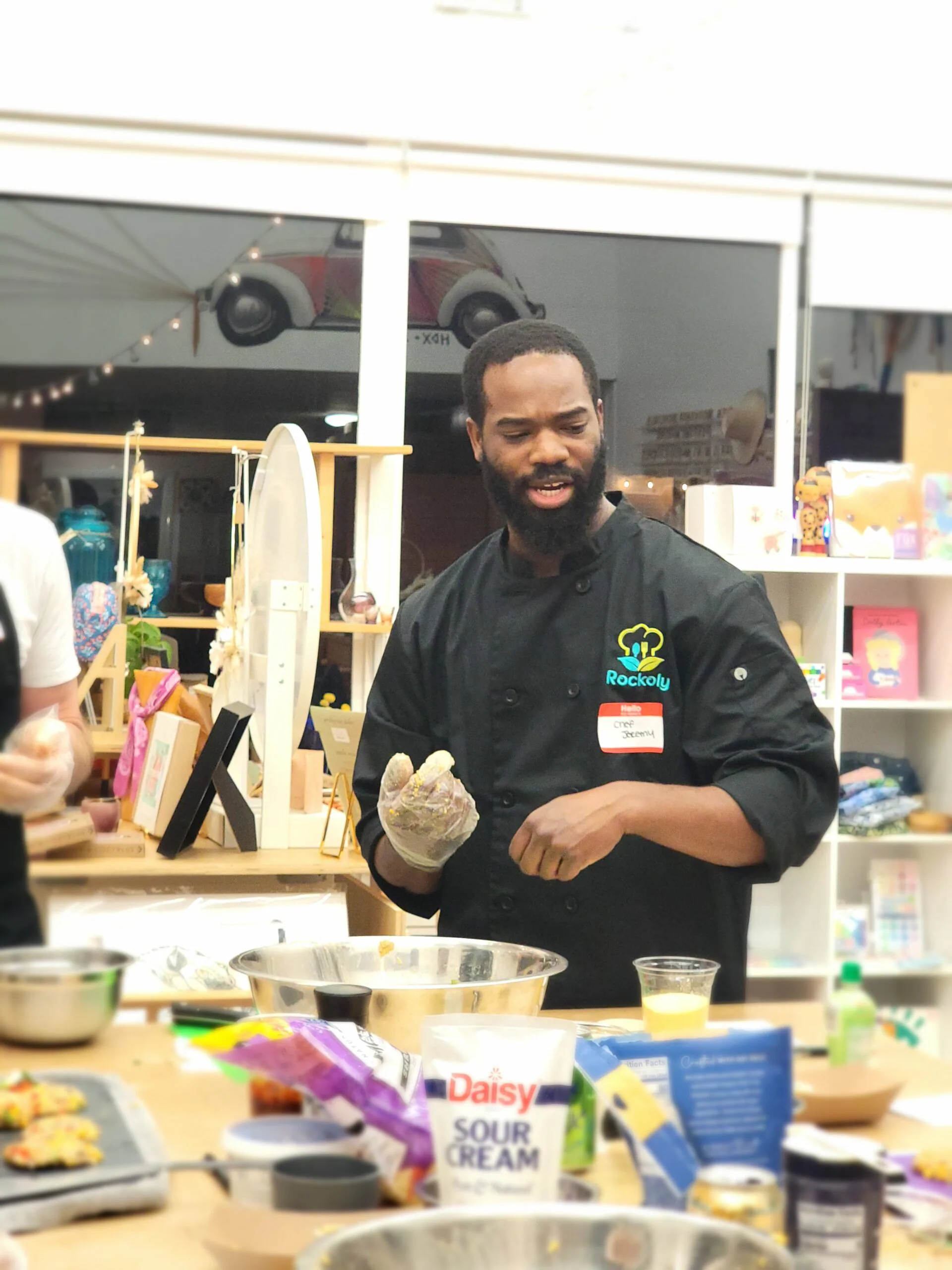
Each runs two hours, and every one arrives with themed appetizers and non-alcoholic refreshments so there is something to eat while people filter in.
If you want a scoreboard — Cavatelli & Competition, where teams shape pasta by hand and compete on a from-scratch pesto, or the Holiday Baking Championship. Both give a quiet room a reason to talk, and the cooking competition format is the one that travels best across seniority.
If you want people moving and mixing — Rolling & Bonding for Japanese maki, Tapas & Talk for Spanish small plates, or Mixology & Mingle, where bartenders guide the team and everyone gets hands-on behind the bar with their own shaker.
If the team is fried and wants to be fed, not tasked — Charcuterie & Connection, building an interactive board of cured meats, cheeses, fruit, nuts and jam, or Sipping & Socializing, a guided pour of sommelier-picked wines with cheese plates. That last one is the only pure tasting on the page — the pick for a group coming out of a long offsite, closer to a wine tasting than a workshop.
And in December — Festive Spanish Tapas joins the list alongside the Holiday Baking Championship. Worth settling early, because December dates are precisely the ones the roster runs out of first.
Bringing a client, a partner, or an exec who is stopping by
Three of these menus were written with outside guests in mind, which is worth knowing in a region where half the calendar is client-facing.
Rolling & Bonding, Charcuterie & Connection and Tapas & Talk all run as client appreciation events as comfortably as internal ones. The reason is structural: guests have something to do with their hands, which removes the long-table problem where one person has to keep a conversation alive for two hours.
The thing to get right is the headcount. Anyone who is going to cook needs to be on the list you give your coordinator, because stations, ingredients and dietary needs are all set to that number. Someone dropping in for ten minutes to shake hands does not need a station at all — appetizers and refreshments are out from the start, and every package includes extra food and drink. For a more formal evening, private dining is the other route.
The Office BBQ
Newer than the rest and easy to miss on the page: the Bay Office BBQ Bash, where the chefs bring the grill, the gourmet ingredients and all the equipment to your workplace and run it there. If your office has outdoor space — and a lot of Peninsula and South Bay campuses do — ask about BBQ team building before defaulting to an indoor workshop.
Your office, or a venue
A conference room, a cafeteria or an open floor all work, and no commercial kitchen is required. Downtown San Francisco, a Silicon Valley campus, the Peninsula or the East Bay makes no difference to the crew; your coordinator goes over the room with you before the date.
Two things push teams toward a venue: a building strict about cooking on site, or a deliberate decision to get people out of the office entirely. Your coordinator lines one up sized to the group. The in-person events page covers both routes.
Headcounts run from 3 to 600 and up, with very large groups usually split by department or across days — worth knowing if you have been assuming a company-wide event was off the table.
Dietary needs cost nothing
Vegetarian, vegan, gluten-free, kosher and no-alcohol are all accommodated at no extra charge when you say so in advance. The chef shops for them, so those guests cook the same dish as everyone else rather than being handed a substitute — which is the difference between being catered for and being accommodated.
If part of the team is remote
They do not have to sit it out. Rockoly runs hybrid events: the Bay Area office cooks with the chef in the room while remote colleagues join live with their ingredients delivered. Same chef, same menu, same two hours.
If the team is mostly distributed, start with the virtual cooking class instead — the virtual catalog has the full range, and plenty of these menus appear in both.
One Bay Area food story worth deploying mid-cook
San Francisco sourdough is named after the city in a way almost nothing else is.
The bacterium responsible for the sour tang in local starters was isolated and formally described in 1971 as Lactobacillus sanfranciscensis — one of very few organisms on the taxonomic record named for a city because of its bread. It works in partnership with a wild yeast: the bacteria make the acids, the yeast does the lift, and the culture gets passed along rather than bought. Boudin has been baking from a mother dough started in 1849, which makes the loaf older than most of the buildings around it.
Deploy it while a team is elbow-deep in dough, or over a Charcuterie & Connection board — where the bread usually gets less attention than it has earned.
Booking, deposit and cancellation
Pick the format first and the date second; the two-hour block is the fixed part and everything else bends around it. A deposit reserves the date.
Cancellation for in-person events runs on a day-based ladder rather than an hours-before cut-off, and it is worth reading before committing budget: at 30 or more days out you are refunded what you paid less any nonrecoverable costs already committed; between 15 and 29 days you choose a 50% refund or a 100% Rockoly credit; inside 15 days payments are nonrefundable, though one complimentary reschedule is yours if you ask 30 or more days ahead. The cancellation policy quotes the same windows, and the event terms control where any summary differs — read them there rather than taking this paragraph’s word for it.
Every event also carries the Love Your Event Guarantee: if yours does not live up to expectations, Rockoly will make it right.
The inquiry form on the Bay Area events page is the quickest route to a coordinator who can talk through dates and rooms.
Other cities
Rockoly runs the same in-person formats in Washington DC, New York, Boston, Chicago, Philadelphia, Seattle, Southern California, Austin and Columbus.
Keep reading
- Team Building in Washington DC: Cooking, Mixology & Wine
- Team Building Activities in Philadelphia: Cost and Formats
- Los Angeles & Southern California Team Building: Rooms, Menus, Costs
- NYC Cooking Classes for Team Building
- Best Massachusetts Locations for Corporate Team Events
- Chicago Team Building: How the Drinks, Menus and Lead Times Work
- Austin Team Building: Dates, Headcount and What Each Change Costs
- Seattle Team Building: Hybrid Events, Kit Shipping and What It Costs
- Columbus Team Building: The Way In, the Menus and What It Costs