 Skip to content

Los Angeles & Southern California Team Building: Rooms, Menus, Costs
Most cities hand a planner one honest choice of room: the conference room, or somewhere that isn’t the office. Southern California hands you four, and two of them are outdoors.
That reads like a nicety until you notice how much it settles: whether a chef may run heat in your space, and whether it opens onto air, narrows the menu list before anybody’s taste gets a say. So with Rockoly’s Southern California events, the room is the first question, not the last box you tick.
The room might not be a room
A conference room works. So does a kitchen, a patio or a rooftop. No commercial kitchen is required: the chef arrives carrying the ingredients, supplies and equipment, and builds the stations on the spot.
What you supply is narrow on purpose: the space — a room with tables and access to a sink — and the guest list. Setup, service and the wipe-down afterwards are the crew’s, and the heaviest thing most hosts lift is the door handle.
Prefer to be out of the office entirely? Your coordinator lines up a venue near your LA, Orange County or San Diego site, sized to headcount. Both routes appear across Rockoly’s in-person events.
When the building says no open flame
Plenty of towers, shared campuses and leased floors do, and it is better to learn that before choosing a menu than after.
Three of the six menus involve no heat whatsoever, so a strict building rules none of them out. Charcuterie & Connection needs a table and nothing hotter — boards built from cured meats, cheeses, nuts, fruit and jam. Mixology & Mingle gives every guest a full station, equipment and ingredients provided, so people build the classics and seasonal sips themselves. Sipping & Socializing is a sommelier-led tasting of bold reds and crisp whites.
Ask facilities the flame question early — one email kills a whole category of late surprise.
Or go the other way and cook outside
The opposite answer is just as available, and the Southern California page pushes it hardest: the SoCal Office BBQ Bash. The chefs bring the grill and every piece of kit and run the session at your workplace — burgers through the BBQ standards, with themed appetizers, beverages and aprons on top.
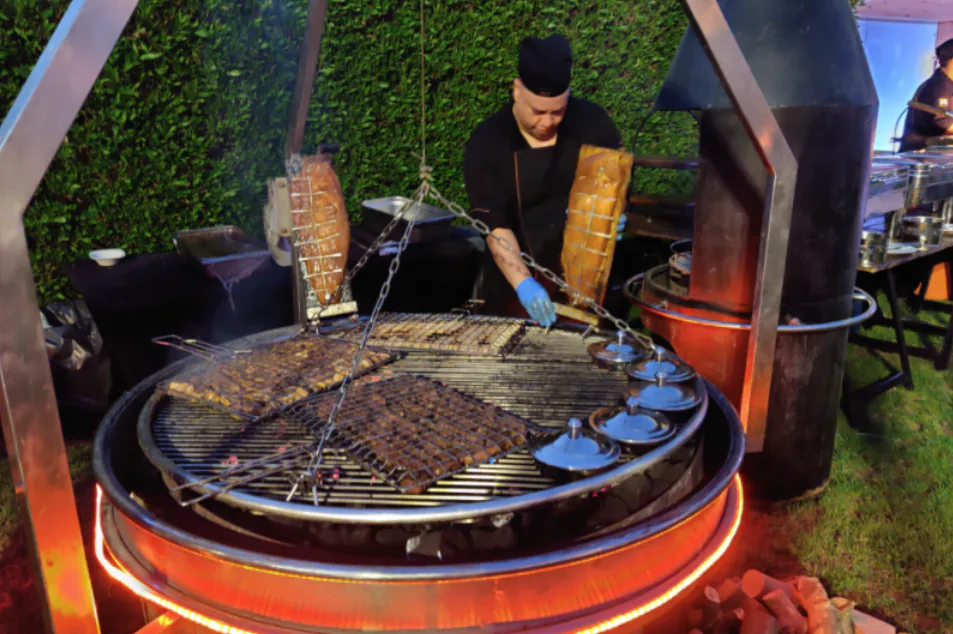
One caveat on the money. The Bash carries no per-person rate on the SoCal page, and BBQ team building prices three packages of its own instead — Grill & Chill Classics from $140 per person, Southern Seafood from $210, Lamb & Wagyu from $230 — so ask your coordinator what the Bash itself lands at.
Every Hass avocado is the same tree
Practically every Hass avocado on the planet is a clone of a single Southern California seedling.
Rudolph Hass, a postal worker, planted a handful of seedlings in La Habra Heights in the 1920s. One refused to graft onto anything else, and because his children liked its fruit best, it stayed, and the variety was patented in 1935. Root rot killed the mother tree in 2002, by which point the Hass had taken over most of the world’s avocado crop — every one a cutting traced back to that plot.
Deploy it at the grill, where the produce is doing as much work as the fire is.
The six menus, and the rooms they suit
Every one runs two hours, with fresh appetizers and non-alcoholic refreshments throughout.
- Cavatelli & Competition — shaping cavatelli by hand and building green pesto from basil, nuts and cheese, then competing on the result. The collaborating matters more than the winning, which is Rockoly’s case for cooking competitions in a line.
- Rolling & Bonding — sushi rice, fresh Japanese maki, and a proper go at plating.
- Charcuterie & Connection — the board built by hand, the easiest session for a building with rules.
- Tapas & Talk — Spanish small plates and sangria, with a whole leg of jamón as the talking point.
- Mixology & Mingle — expert bartenders, a station each, and non-alcoholic versions of every drink as standard.
- Sipping & Socializing — the sommelier-guided pour, and the only one asking nothing of anyone’s hands.
Browse every in-person workshop side by side for the fullest catalog. The in-person menu list also carries three holiday-season items — Festive Spanish Tapas, a Holiday Baking Championship and a Festive Activities add-on — which the SoCal page does not show, so ask your coordinator before promising a team any of them.
The two numbers on every menu card
All six cards print the same pair: from $150 per person hosting in your own office, from $250 per person at a venue Rockoly lines up. Both are floors, not quotes: the rate follows the menu and the headcount, and falls as the group grows. Size a budget off them and expect the figure to move.
The rate buys the event rather than the catering — chef instruction, every ingredient and all the equipment, the crew who set up and clear away, more food and drink than anyone gets through, free customizations from your coordinator, and insurance.
Dietary requirements — vegetarian, vegan, gluten-free, kosher, no alcohol — cost nothing extra when flagged in advance, and blending two menus adds nothing either.
Only named extras move the number, and not all the same way. Custom aprons carrying your logo and a take-home cocktail shaker set are each $40 per person; the Wine Lover Kit on the Sipping & Socializing page is a flat +$40. Cinnamon churros, a vegetable paella main, wine and sangria are named as extras with no published rate, so ask what they add.
Book it around the drive, not the workday
A mid-afternoon start is usually right: the session finishes near the end of the day, so nobody drives the same stretch of freeway twice in one afternoon.
If your people are spread across the basin, resist nominating one address and letting geography decide who attends. Run the same menu on separate days at your Los Angeles, Orange County and San Diego sites — every office gets an event rather than a commute.
Count your runway in rooms, not weeks
One event in one office needs three weeks for a cooking event, four for a happy hour — and Mixology & Mingle is the menu the SoCal page calls a happy hour. Sipping & Socializing is written up as a wine tasting instead, so ask which clock a tasting runs on. Three sites on separate days means three chefs and three rooms, and wants noticeably more runway; the page puts no number on that.
Rush dates sometimes come together when a chef’s day is open, and both drinks workshops advertise instant booking two weeks out on their own pages, so a tight date is worth raising. Size is rarely the obstacle either: events run from 3 people to 600 and up, the biggest split by office or department — Rockoly has run in-person events at genuinely large scale.
The deposit, the reschedule and the refund ladder
Start with the part teams actually use: one complimentary reschedule whenever you give 30 or more days’ notice, which covers most of what goes wrong with a corporate date.
Refunds run on a day-based ladder, never an hours-before cut-off. At 30 days or more, you are refunded your payment minus any nonrecoverable costs Rockoly has already committed. The 15-to-29-day window is a choice: a 50% refund of the recoverable event amount, or a Rockoly credit for 100% of that same amount. Under 15 days there is no refund.
A deposit holds the date; credit card, ACH transfer and check are all accepted. This section is a summary — the cancellation policy page carries the windows, and the event terms are the governing document both point back to. A custom-quoted event runs on your proposal’s terms instead, which paying the deposit accepts. The Love Your Event Guarantee sits over all of it.
Access goes on the brief, next to dietary
This is a planning conversation, not a day-of scramble, and it belongs in the same breath as dietary requirements. When your coordinator is sourcing the room too, access joins headcount on the brief instead of quietly becoming your problem.
Name the specific thing: an interpreter, a station someone can work sitting down, clear routes between the tables. Raise it in the date conversation and your coordinator can say what your room will take.
None of this depends on confidence in a kitchen. Nothing is attempted before it has been shown, the jobs are small enough to share, and no one is called out in front of the room. Neither drinks menu asks anyone to cook, and the charcuterie board is built at a table rather than a stove.
Hosting clients, not just staff
One of the better uses of these menus: a hands-on event gives a client something to do besides small talk across a dinner table.
Charcuterie & Connection turns into a board-building competition. Tapas & Talk keeps a room circulating rather than settling into cliques. Sipping & Socializing puts a sommelier in the room to carry the conversation. No one needs cooking experience.
Those custom aprons earn their $40 per person here: guests leave with branded kit they will actually wear. If this becomes a quarterly habit, the appreciation events page covers recurring programs and post-event reporting.
If part of the team is somewhere else
These menus are in-person only. If your team is genuinely distributed rather than split across three SoCal offices, start with a virtual cooking class, where ingredients ship to each participant; the virtual catalog has the full range.
When you are ready, send your date and headcount through the inquiry form on the SoCal events page and a coordinator comes back with rooms, chefs and a firm number.
Other cities
Rockoly runs the same in-person formats in the Bay Area, Seattle, Austin, Chicago, Columbus, Boston, New York, Philadelphia and Washington DC.
Keep reading
- Team Building in Washington DC: Cooking, Mixology & Wine
- Team Building Activities in Philadelphia: Cost and Formats
- Bay Area Team Building: Cooking, Cocktails & What It Costs
- Chicago Team Building: How the Drinks, Menus and Lead Times Work
- Austin Team Building: Dates, Headcount and What Each Change Costs
- Seattle Team Building: Hybrid Events, Kit Shipping and What It Costs
- Columbus Team Building: The Way In, the Menus and What It Costs