Nothing in your office has to change for a Rockoly event to run there. No kitchen gets found, no equipment ordered, no ticket opened with facilities. The chefs carry every piece of it in with them.
Which loads the whole thing onto one small word. In. The Columbus in-person events page is unusually direct about it: the crew needs a place to unload and a clean route from there into the room, the one thing worth checking before you confirm a date. Menu, headcount and budget all bend late. A loading route does not.
The best argument for booking one sits at the end of this post. It only cashes if the crew gets through the door.
What your building has to give the crew
Three things, and you already own all three: tables, a way in, and the room to itself before your team walks in.
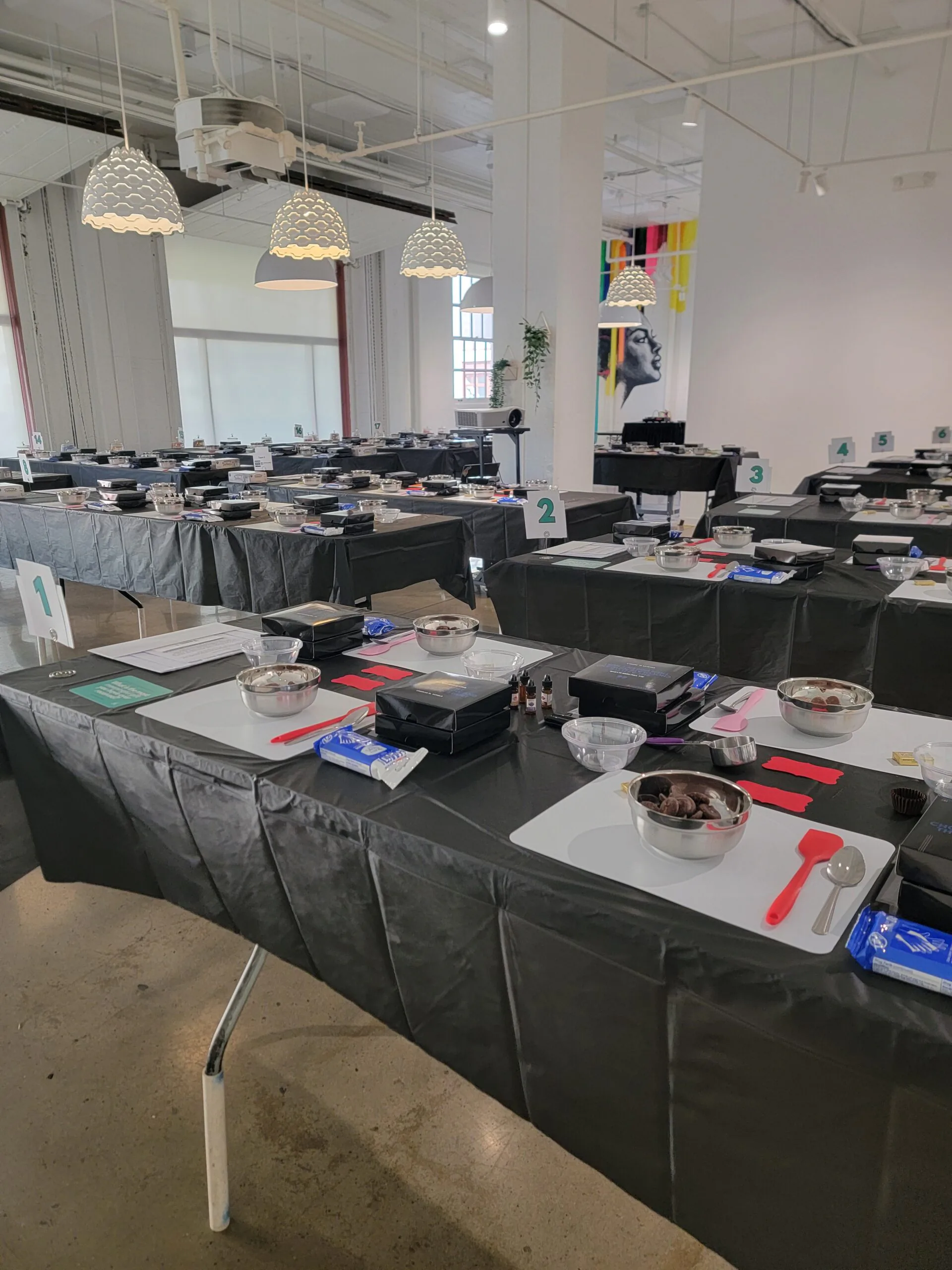
The chefs turn up carrying the food, the supplies and the equipment, then build stations on ordinary tables. No kitchen to locate, nothing for facilities to install. All six menu pages print one short list of what your side supplies: a room with tables, access to a sink, somewhere for the chef to set up.
Downtown and an office park ask different questions
Rockoly’s Columbus footprint reaches from downtown out through Dublin and Westerville, and the unload question has a different answer at each end. A downtown tower usually means a shared dock, a service entrance and a lift other tenants want too. A low-rise off a parkway means a door near a parking space. Not harder — just a different conversation.
The most demanding version of it is set out on Rockoly’s New York page: a building there may turn a vendor away at the dock until it has seen proof of coverage. That travels usefully. Event insurance is already inside every Rockoly in-person package, so the coverage exists before anyone asks; what your planner needs is whatever your own building demands of a vendor, as soon as you have a date.
Three things to say out loud before you confirm
Your coordinator goes over the space with you in advance, and that is where the access question gets settled. Three answers do most of the work: where a vehicle can stop, whether there is a service entrance or a freight elevator, and what the building demands of a vendor before letting one in.
None of it is a form to file or a clock to beat. It is a description of a place, and the only way to get it wrong is optimism. A lobby that slows the load-in eats the crew’s setup buffer — better said before the date than on it.
When the honest answer is that access is hard
Say it early. That is the Columbus page’s own instruction: if your building makes all of this difficult, say so, and your coordinator will look at a nearby venue instead.
Notice what this is not: the size question. A room can be big enough for forty people and still sit at the wrong end of a building a trolley cannot reach. The in-office format assumes the first route; a venue is the answer when the building itself is the obstacle, and it starts from a higher floor.
One extra has a price. The rest is inside the rate.
On the Columbus page exactly one extra carries a published figure: aprons printed with your team’s names or a logo, $59 per person. The menu pages list their own extras, like a take-home shaker set with Mixology & Mingle and a wine kit with Sipping & Socializing.
Everything a team usually budgets separately is already in the rate: the shopping and the hardware, every ingredient and every piece of equipment, more food and drink than a room gets through, a coordinator whose customizations are not billed back, setup and cleanup.
The rate itself sits under the cards, where all six print an identical pair of floors — $150 per person to start in your own office, $250 to start at a venue. No menu opens lower than another. What sits on top depends on the menu and the headcount, which is why the page hands the number to a planner.
Group size starts at three, with no stated ceiling above six hundred; very large teams usually get split by department, or run across two days.
Six menus, and what each one asks of a room
Four are cooking menus, two are drinks, and the room they ask for is the same. Each runs two hours.
Cavatelli & Competition is pasta shaped by hand followed by a contest for the best pesto. Rolling & Bonding covers sushi rice, Japanese maki rolls and the plating. Charcuterie & Connection has teams building boards — cured meats, cheeses, olives, jam, fruit and nuts. Tapas & Talk runs patatas bravas, pan con tomate, piquillo de atún and melon con jamón under a whole leg of jamón, with sangria poured alongside.
The last two involve no cooking at all — the quiet argument for them when your only bookable room has carpet. Mixology & Mingle puts everybody behind the bar with expert bartenders, working through classic cocktails and seasonal sips. Sipping & Socializing is a sommelier walking the group across bold reds and crisp whites. All six are browsable in the in-person catalog.
Extending a menu into a meal
The four cooking menus are not fixed sets. A main course and a dessert can be added on top: with the tapas, vegetable paella and cinnamon churros; with the sushi, mochi; with the pasta, tiramisu. Menus also combine or get cut down, and drinks can run alongside the food. The two drinks events have no course to extend into; what they add is a keepsake set.
Raise it while you are still discussing the space. A longer menu is a longer load-in.
A grill changes the geometry
Columbus offers an in-office BBQ, the one format where the room question stops being about a room. The barbecue team building page is blunt about why: a grill has to sit in open air with clearance from the building, so the cooking cannot follow everyone indoors.
Which makes it an office event that happens outside the office, on whatever open ground the site has, at roughly fifteen feet square of clear area per grill station, on packages and figures of its own.
The crew sets the room, then un-sets it
The load-in happens twice, and the second is the half nobody books for. The room gets built before your team walks in and put back once they have gone, so by evening a conference room is a conference room again.
Doing that takes five roles: a chef or mixologist teaching hands-on, the planner who built the menu and room plan with you, helpers running the stations, serving staff on drinks and extra courses, a cleanup crew on dishes and tables.
Diets go into the menu, not around it
A gluten-free teammate, someone keeping kosher, two vegetarians, a vegan, a colleague who has stopped drinking: share it with your coordinator in advance and each gets planned into the menu itself. None of it moves the quote.
The same holds at the drinks events: Mixology & Mingle puts out snacks, appetizers and non-alcoholic refreshments alongside the cocktails, Sipping & Socializing cheese plates and the same again.
Columbus tests food built to scale. These menus do the opposite.
This city has quietly shaped how the country eats out. The first Wendy’s opened downtown in 1969, White Castle put its head office here in the 1930s and never moved it, and for decades Columbus has been the food business’s favorite test market: close enough to the national averages on age, income and household mix that chains launch a product here and watch before going nationwide. Any new fast-food item of the last fifty years was probably eaten here first.
Every one of those products is engineered toward one goal: to be identical everywhere it lands. Rockoly’s menus are engineered against it. Cavatelli gets shaped one piece at a time by people who have never done it. A board is an hour spent arranging salt, smoke and time, then eating the evidence. The Columbus page says it best: “Neither scales, tests or ships, which is rather the point of booking one.”
Weeks ahead, a deposit, and refunds counted in days
Three weeks of notice is roughly what a cooking event wants; a happy hour wants four. If your date is closer, the Columbus page says to ask anyway, because rush bookings sometimes work. The in-person team events page sets those windows network-wide.
Booking starts with the inquiry form on the Columbus page, or an email to events@rockoly.com. A planner returns open dates, menu suggestions and a quote; a deposit holds the date, by credit card, ACH transfer or check.
Refunds are counted in days. Cancel thirty or more days ahead and what you paid comes back, less any nonrecoverable costs already committed. Between fifteen and twenty-nine days out the choice is yours: a refund of 50% of the recoverable amount, back to the card or account you paid from, or a Rockoly credit worth 100% of it. Inside fifteen days nothing is refundable, though one complimentary reschedule remains available if you ask thirty or more days out.
The cancellation page quotes those windows, and where any other page or summary differs, the event terms and conditions control. One rung sits above both: if your event was custom-quoted, your proposal’s terms govern it, and paying the deposit is how you accept them. The Love Your Event Guarantee sits over every Columbus booking regardless.
Other cities
Columbus is one of ten metros with a page of its own. The rest: Austin, Bay Area, Boston, Chicago, New York, Philadelphia, Seattle, Southern California and Washington DC. The six menus and the two floors under them are the network standard, not a Columbus arrangement.
Keep reading
- Team Building in Washington DC: Cooking, Mixology & Wine
- Team Building Activities in Philadelphia: Cost and Formats
- Bay Area Team Building: Cooking, Cocktails & What It Costs
- Los Angeles & Southern California Team Building: Rooms, Menus, Costs
- Chicago Team Building: How the Drinks, Menus and Lead Times Work
- Austin Team Building: Dates, Headcount and What Each Change Costs
- Seattle Team Building: Hybrid Events, Kit Shipping and What It Costs